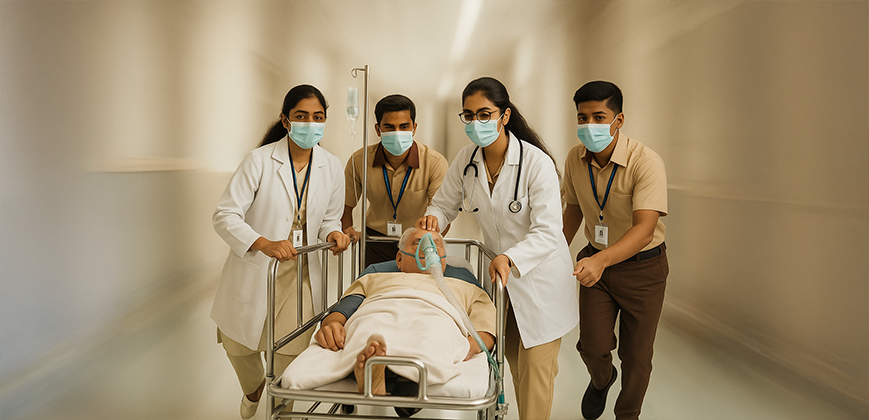
B.Sc. in Accident & Emergency Care Technology
“ Act fast, save lives. Become an emergency care expert with our B.Sc. in Accident & Emergency Care Technology.”
Duration:
4-year undergraduate program — 3 years of academic learning plus a mandatory 1-year clinical internship
Co‑educational Institution
Eligibility Requirements
- Must have completed 12th grade (Higher Secondary) from a recognized board
- Required subjects: Physics, Chemistry, and Biology or Mathematics
Course Content
While Prana Institute does not publish a detailed syllabus, general academic modules for B.Sc. Accident & Emergency Care Technology typically include:
- Fundamentals of human anatomy, physiology, and biochemistry
- Emergency medical services (EMS) protocols and triage
- Trauma care and management of critically ill patients
- Pre-hospital care and ambulance operations
- Advanced life support techniques (BLS, ACLS, PALS)
- Emergency surgical procedures and instrumentation
- Patient assessment, stabilization, and emergency pharmacology
- Clinical rotations in Emergency Room (ER), ICU, and trauma units
Career Prospects
Graduates are trained to function efficiently in high-pressure emergency environments, with career options such as:
- Emergency Medical Technician (EMT)
- ER/Trauma Care Technologist
- Ambulance & Pre-hospital Emergency Staff
- Disaster Response Specialist or Emergency Coordinator
- Unit Managers or Clinical Instructors in Emergency Care departments
Accreditation & Affiliation
Affiliated with The Tamil Nadu Dr. M.G.R. Medical University, a well-recognized institution for allied health sciences education in Tamil Nadu Source: alliedhealthadmission.com
Admissions & Fee Structure (Summary)
- Eligibility limited to Indian citizens and Tamil Nadu natives — native and community certificates required to avail state reservation
- Admissions conducted via Tamil Nadu’s centralized counselling under the Allied Health Sciences stream
- Annual tuition fee (self-financing colleges): Approximately ₹33,000–₹45,000 per annum (exact fee may vary slightly by institution and stream)